Showing posts with label history. Show all posts

Taking the long view


C.F. Beyers Naudé and Dorothee Sölle, at the end of a long interview-conversation in 1985.

(Published first in Dutch --the conversation took place in the Netherlands-- the interview came out in English as Hope for Faith: A Conversation, jointly published by Eerdmans and the World Council of Churches in 1986.)

Sölle:

I think Christ didn't promise us victory... Christ promised us life, and that includes death. Christ didn't tell us that we would win. Other people tell us that all the time... We hope to win; we fight to win; we give our blood and our lives... but I think we cannot understand our own struggle in terms of success and non-success.

Naudé:

Well, the question that I would like to put to you would be this: Do you, in yourself, have the strength to endure whatever may come to you by way of disappointment, by way of rejection, by way of non-recognition, by way of waiting, perhaps your whole life, without being able to participate in the victory of the truth that you are standing for? Do you believe that you will be able to sustain yourself through these years up to the very end?

Sölle:

I am thinking of a friend's answer to that when I was in a state of despair, and had this sense of meaninglessness and never reaching anything, and then he talked about the cathedrals which were built during the Middle Ages. Most of them were built over 200 years, some over 300 years even, and some of the workers in those cathedrals never saw the whole building, they never went to pray there, they never saw the glass and all the beautiful things they gave their life for. And then this friend said to me: "Listen, Dorothee, we who are building the cathedral of peace, maybe we won't see it either. We will die before it is complete, and yet we are going to build it. We are going on even if we won't live in that building." 

XXX

xxx

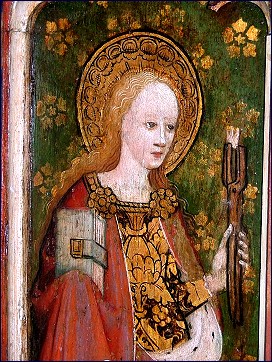
Apollonia, the toothy saint


I had oral surgery a few days ago and have been meaning to write this post since last week, but life has been busy, first with a little road trip out of state to a family Bar Mitzvah (photos on Facebook for those of you who are FB people) and then a wedding of two young Guilford alumns (ditto, smaller album), then getting ready for the surgery, and finally the surgery and recovery. I am doing fine, healing slowly and being creative with liquid and soft foods, but the point of this post is the saint for tooth trouble and dentists, Apollonia.

Apollonia was a Christian woman from Alexandria, Egypt, in the 3d century of the Common Era. Part of her martyrdom involved getting her teeth smashed and/or pulled out; hence she is often represented in Christian iconography with pincers and a big tooth.

Apollonia's torturers threatened her with death by fire if she did not renounce the faith. In her zeal for the faith she threw herself on the pyre before they could take her there.

One of my old friends says she bets that it had nothing to do with zeal for the faith and much more to do with the fact that the tooth pain was so horrid that anything was better than enduring it any more! She's got a point... The fact remains, though, that Apollonia had already lived a long life of holiness and service and that she was a woman of deep devotion and determination.

The image above is from an English church. You can find it on an interesting website on Norfolk churches.

Both Orthodox and Catholic Christians observe Apollonia's feast day (February 9). I think we Anglicans should join them. After all, she is an ancient Alexandrian martyr.

Note: Alexandria was a virgin but probably also a deacon. parthénos presbûtis, the phrase used to describe her in the martyrologies, does not necessarily mean "an older virgin" but more likely, according to the scholars, an ordained deacon/ess. There is plenty of scholarship on women deacons, not just as deaconesses as an unordained order, but as ordained deacons.

Did you know there has even been an international Orthodox conference on women in the diaconate whose proceedings, published in 1998, have been endorsed by His All Holiness Patriarch Bartholomew, the Ecumenical Patriarch?

Here's a rather dreadful 15th century painting of Apollonia's torture. I mean the torture is dreadful, not the painting.

And then there's this (Heilsbronn Cathedral, Bavaria, 16th century):


This is likely a modern facsimile of medieval iconography. It is the illustration on a dental office called "Apollonia House" in the U.K.

This is a serigraph from the 1980s.

This is probably the best known representation, a painting by Francisco de Zurbarán (early 17th century).

I am rather more fond of the English one at the top of this post.

There are images of Apollonia all over Europe.

There are also reputed pieces of her in several countries including Italy, Belgium, Germany, and Portugal.

Saint Apollonia, pray for us!

Why Mexico City

Someone on Facebook asked why my parents got married in Mexico City.

Since it's too long an answer for Facebook, here goes.

My father got his master's degree at the Columbia University Journalism School. He was not yet 21 years old. He graduated at the top of his class (1939) and was one of three recipients of a Pulitzer Traveling Fellowship. This gave him the opportunity to travel and write for a year.

He headed for Europe in June. He knew by then that he wanted to be a foreign correspondent. He traveled through Western Europe, then Eastern Europe and the USSR and back to Western Europe. Well, if you remember your world history, you remember what started happening on September 1, 1939. World War II broke out.

My father had hoped to stay and find work as a war correspondent, but despite his letters of recommendation, he couldn't find a job, and he went home, not on a Cunard liner as he had on the way over, but on a freighter taking refugees back to the U.S. Among the passengers was my father's cabin-mate --not by choice-- who turned out to be, so he said and my father had no reason to doubt him, Prince Felix Yussupov. You may remember him as the man who killed Rasputin. My father notes in his memoir that he "had never before met anybody who had killed a man, let alone boasted about it. Sharing a cabin with him was fun on an otherwise tense voyage, but I didn't sleep too well thinking about my new friend, the murderer." (p.23)

FoAoH decided to finish up his fellowship in Mexico City, so off he went. There were many estadounidenses there at the time: Mexico was warm, welcoming, and inexpensive. It was also, as my father discovered, desperately poor, and the Mexico City metropolitan area was already crowded then with a population over five million. He started freelancing and stringing (working part-time) for several newspapers and news services.

After he'd been there for a while, MoAoH got sick of waiting up in Brooklyn. She'd finished college by then, so, as I like to tell it, she said to her parents "Bye-bye, I'm going to marry FoAoH!" Okay, it wasn't entirely like that. My parents had both turned 21 by then, it was now early 1940, and my father saw that they could live quite well on under $15 a week, so they decided that they would get married sooner rather than later. My father wrote a letter to my mother's father, as one did in those days, and promised he would take good care of her. They had known each other for years so my mother's parents knew my father was a trustworthy sort, and they knew my parents wanted to get married. People didn't "get engaged" in those days, at least in my parents' circles. It was the Depression and nobody was buying or showing off diamonds on their left ring fingers, and my mother's family was never terribly conventional anyway, though they certainly believed in marriage.

My parents met at James Madison High School in Brooklyn, New York. They didn't become sweethearts till college but were in the same group of friends in high school. Like many in their high school --mostly children and grandchildren of Jewish immigrants-- they attended public colleges: she went to Hunter College, which was all women at the time; he went to City College, which was all men. Both of those schools were way uptown in Manhattan, of course, and my family's version of "In my day we had to walk five miles to school in the snow, uphill in both directions!" was "It was the Depression, we lived at home, and we took the subway to school an hour and a half in each direction." Three hours of commuting a day to get an education. My mother is the one who talks about this.

My father was editor of the college newspaper and helped get a corrupt college president on the road to resignation, but that is another story and you can read it in FoAoH's memoir. He went on to a private university (Columbia) for professional journalism study. My brother also went there, years later, and I contemplated doing the same but didn't.

Back to the Mexico story. My mother took the bus down to Mexico City from New York. Yes, the bus. More like buses. I think her first stop was Indianapolis because she had an uncle there. Not sure whether or where she stopped after that, but it was a five-day trip. At any rate, she got to Mexico City safe and sound on a Friday, and the following Tuesday she and my father were married.

They married at the American Embassy because they were patriotic young people and wanted to be married on American soil. But the Ambassador wasn't empowered to officiate at weddings (unlike some other foreign diplomats) so they got a Mexican Justice of the Peace. Only civil marriages were valid in Mexico. A wedding at the JP's Registry office would cost two pesos, but they decided to splurge and go for the 32-peso wedding, which is what it cost to get married outside the Registry. 32 pesos in those days was about 8 dollars.

Foreign Service officers couldn't officiate at marriages but they could witness them (in the church that's the same thing, so I don't quite get the distinction, but there you have it) and issue a certificate of marriage so in addition to the Mexican wedding certificate, my parents got a U.S. certificate (for one dollar extra). I'm not sure whether the Consul General or the Ambassador signed the piece of paper, but they were both there. The Ambassador at the time was Josephus Daniels, a former Secretary of the Navy under President Woodrow Wilson who was a former newsman -- how appropriate. I remembered he was a Southerner, but what I had forgotten and just re-read in the Mexico chapter of the memoir is that he was the founder-editor of the Raleigh News & Observer. That's Raleigh, North Carolina.

Meanwhile, my paternal grandparents had expressed the desire for my parents to have a Jewish wedding ceremony, so several days later PoAoH located a rabbi, which in Mexico City was not so easy, and he witnessed and officiated at a religious ceremony. It was in Spanish and Hebrew and they had a sheet or a tablecloth for a chuppah (the traditional wedding canopy) and my father didn't have a kippah (yarmulke) so he used a handkerchief tied at four corners. The part of this story I love is that the rabbi lived on Jesus Maria Street. Now there's a title for a novel: The Rabbi on Jesus Maria Street.

Parents of Acts of Hope did have a little reception with a wedding cake. The cake was the work of two Greek-American pastry cooks from Manhattan who after fighting in the International Brigade in the Spanish Civil War (i.e. against Franco's forces) had settled in Mexico and opened a restaurant and bakery.

My father's memoir doesn't say and I haven't asked my parents, but it occurred to me a few years ago upon re-reading my father's description that these guys, Nick and Mike, were probably a couple. But maybe they weren't.

The cake had two white doves on top.


The big story in 1940 in Mexico was, of course, Trostsky's assassination, and my father, as a freshly minted journalist, got to cover it. There was a substantial cast of characters in the background shenanigans leading up to the assassination, including an American woman who had been one of Trotsky's aides. My father was stringing for the Jack Starr-Hunt News Service and among their clients was the N.Y. Daily News tabloid, which could care less about the politics of the story. Who cared if Stalin's arch-enemy had just been killed? The Daily News fired off to my father a cable that read "RUSH 1,500 WORDS GIRLIE ANGLE." Welcome to highfalutin foreign correspondent work.

After a few months in Mexico, with the fellowship year over, my parents returned to the U.S. and Brooklyn, where both their families lived. My father got a stop-gap editing job at the Brooklyn Academy of Music while hunting for a real job in journalism. At last, after six months, a real job materialized, and off my parents went to Herkimer, New York (for those of you who don't know, that's in the boonies, at least from a New York City perspective) where my father worked on the Evening Telegram newspaper for the magnificent sum of $35 per week.

The following year Pearl Harbor happened and my parents moved to Washington.

But that is another story.

Updating the book list, and a plug for Anita Diamant's new novel

I am digging out from under all manner of things. In the midst of this and the usual house-cleaning, literal and metaphorical, that accompanies the advent of Advent, I am updating this blog. I hadn't updated the reading list at the right in months. It isn't complete, but it gives you a snapshot of what I'm reading or re-reading these days.

The Aquino and Rosado-Nunes book is composed of the proceedings of the first Inter-American Symposium on Feminist Intercultural Theology. This was the first ever formal gathering of Latin American and U.S. Latina feminist theologians. Some social scientists also participated in the meeting. Why is this book significant? Because, one of its introductory essays notes, for the first time in the history of Christianity in the Americas, feminist theologians of the United States, Latin America, and the Caribbean were able to meet together to share our common concerns and visions about the present and the future of our theological work, on the basis of intercultural hermeneutical frameworks. ("Hermeneutical" in this case means "interpretive.")

The book by Renate Wind (which is way overdue at a certain library in California) is a biography, the first, I think, of the late Dorothee Sölle. {This next sentence added a day later after the original post:} Wind has previously written about Dietrich Bonhoeffer; it's not surprising she would be drawn to Sölle, who in so many ways was spiritual and theological heir to Bonhoeffer. The eco-books by McFague and Ruether (the Ruether one is an edited volume featuring writings from Asia, Africa, and Latin America) are triple-purpose books: they are part of my reading and referencing for the Big Tome; I have students reading a couple of them; and I am looking at them as I ponder my sermon for this coming Sunday, the first in Advent. I haven't preached since September. What does the environmental crisis have to do with Advent? You'll find out after I preach. Unless the Holy Spirit sends me in another direction.

I actually cheated by listing Anita Diamant's new book, Day after Night, because I read and finished it last weekend. Anita gave it to me last Friday when she came to my talk on prayer at Harvard (about which more later) and I started reading it that night and finished it on the first of my two plane flights the next day. It's both deep and a page-turner.


I am just starting Louise Erdrich's The Last Report on the Miracles at Little No Horse, which a colleague lent me. "It's about a woman who dresses up as a man so she can work as a Catholic priest, so you can see why it made me think of you," he said. (!) The priest in the book is a member of the Ojibwe Nation, as is Erdrich.

You may or may not have noticed that these are the first fiction books I've listed in eons, or perhaps ever since I started blogging. I am starved for fiction and haven't let myself read any, except for the occasional mystery novel, in something like four years. Ridiculous. Just because I've been trying to finish a work of non-fiction doesn't mean I shouldn't be reading fiction. I find reading fiction life-giving. Do you?

Rest in peace, Uncle Walter

**********
Walter Cronkite, journalist, 1916-2009.
******
Rest in peace. And thank you.


Obituary here.

Third U.S. Sikh-Catholic Dialogue Retreat


Really!

I get all kinds of ecumenical and interreligious news in the (e-)mail every day and this was one of the more interesting articles to hit the inbox. No, I don't read them all, but I like to receive them nevertheless. I am a religious news pack-rat.

So here is the article on the Sikh-Catholic retreat.

I knew Francis Tiso, the head of the Catholic delegation to the retreat, because we overlapped at Harvard Divinity School for a year during our M.Div. studies. Back then he went by "Frank" and he wasn't anywhere near getting ordained. He went to a contemplative community with Brother David Steindl-Rast after graduation, not as a monk, but as part of an experiment in contemplative living. Interestingly, he is a priest of an Italian diocese. He also did doctoral work in Buddhist studies.

Francis Tiso and I also overlapped when I was in the Bay Area and I had no idea we did. Sounds like someone with whom to have an interesting conversation.

The BBC has a good overview of the Sikh religion, with resources, here.

To learn more about Sikhism and Sikhs in the United States, go to the Pluralism Project's website, and see the section on Sikhs here.

There were quite a few hate crimes against Sikhs immediately following 9/11 because Sikh men wear a turban and their attackers assumed they were Muslim.

Lost and found

I have been cooking an essay called "Lost Things" which has suddenly started flowing out of my fingers. It may or may not be my next piece for the Episcopal Café, whose editor has been extraordinarily patient with my absence from my contributor duties during this difficult year. I have been musing about the things I have lost or have had stolen from me over the course of my life and about why their absence bothers me. The essay comes straight out of those musings.

In the course of hatching a rough draft, I have remembered once again one of my favorite books from childhood, one which I reread many times as a young adult and which my parents had to give away or leave behind during a major move. I cannot hope to track down that very copy of the book but in these days of the World Wide Web it is possible to find a book that has long been out of print. Every so often I search for it on the internet.

Lo and behold, after two and a half pages of writing I began poking around for the first time in months, and I found not only copies of the book available for sale but confirmation that the book was in fact the one I loved in the form of a picture of the book cover! The first few copies I saw online had either no picture of a cover or a very different picture from the edition I remember. So here is a picture of my beloved book. At some point I will order a copy for myself, or perhaps I will wait till my next trip to France or ask a friend to get it for me. I really want to read the book again but I am just happy it still exists somewhere.


By the way, the book is full of wonderful fables and legends and tales: how certain streets in Paris got their name, what a fortune-teller said to one of the Medici queens (two Medici women married French kings), who built what when, and how the city got its start. That part is not fable but historical fact. It is through this book that I learned about the Parisii, the tribe that gave Paris its name. Paris was a city of boat people, clustered on a few islands that were later consolidated into the two islands we know at the heart of the city. The Romans, of course, took over the islands when they conquered Gaul, did a lot of building, and named the city Lutetia (Lutèce in French), though some sources say that the city's name was already Lutetia by the time the Romans conquered it in 52 BCE. Bits of Roman amphitheatre and baths survive, but the Parisii came first and it is their name that endures.

The book is also chock-full of stories of the saints, and I still remember them: Denis, martyred (on what became known as Mons Martyrium, later abridged to Montmartre) and carrying his head in his hands all the way to what is now the town of St. Denis, where a basilica commemorates him; Geneviève the shepherd girl, praying away the Huns; and others, but those two especially.

Interesting how stories pour out of us when we are ready, or sometimes long after we were ready. I should have known by the grumpy mood of the last few days that I was cooking several pieces of writing. Reports and other mundane word processing stood at the doorway and blocked them. I must get back to those duty-bound words, but now I know what was ready to come forth, and there will be no stopping it.

Yes, I remembered that today was International Workers' Day


I just didn't have anything new to say about it.

I do have lilies of the valley in my garden, though.

What's the connection between labor and lilies? See my post of two years ago. (A follow-up on this.)

A little bonus on Haymarket and May Day from the Encyclopedia of Chicago History.

Photo: The Haymarket Memorial, Chicago. (Erected only in 2004!)

April 4: two MLK anniversaries and a third, with the Freedom Seder

The Revs. Jesse Jackson and Martin Luther King, Jr. on April 3, 1968, before MLK gave the last speech of his life. Photo: Ken Ross via American RadioWorks. He was assassinated the following day.


Today is the anniversary of the 1968 assassination of the Rev. Dr. Martin Luther King, Jr. in Memphis, Tennessee.

It is also the anniversary of the "Beyond Vietnam: A Time to Break Silence" speech which he gave exactly a year before, on April 4, 1967, at the Riverside Church in New York City.

Although I have posted the speech before, I post it here again for those who have not read or hear it. The link includes audio as well as transcript text. The speech is long but well worth pondering.

A good feature on the last year of King's life (the "Beyond Vietnam" speech, the Memphis sanitation workers' strike, et al.) is here, courtesy of American RadioWorks. It includes both text and audio.

And, with thanks to my colleague the Rev. Susan Redfern Spencer (also here), via Facebook, the note below from the Shalom Center and YouTube video:

On April 4, 1969, the first anniversary of the death of Dr. Martin Luther King, the third night of Passover, hundreds of people of varied racial and religious communities gathered in a Black church in the heart of Washington DC to celebrate the original Freedom Seder. For the first time, it intertwined the ancient story of liberation from Pharaoh with the story of Black America's struggle for liberation, and the liberation of other peoples as well.

To celebrate the 40th anniversary of the Freedom Seder and to address one of the greatest dangers ever to face the human race --the danger of "global scorching" worse than the traditional "Ten Plagues"-- The Shalom Center has initiated a New Freedom Seder for the Earth was scheduled to sponsor it in Washington DC on March 29, 2009. Here is more information on
the original Freedom Seder and the New Freedom Seder for the Earth. (You can download the text of the Seder for the Earth at that last link.)

John Hope Franklin, R.I.P.


The great historian John Hope Franklin died yesterday at the age of 94.

The Washington Post has several pieces about him including an obituary and tribute with a slide show here.

Duke University, one of the schools at which Professor Franklin taught, has a biography here.

From the WaPo obituary by Wil Haygood:

Franklin was among the first black scholars to earn prominent posts at America's top -- and predominantly white -- universities. His research and his personal success helped pave the way both for other blacks and for the field of black studies, which began to blossom on American campuses in the '60s.

In time, a second generation of eminent black scholars -- Harvard's Henry Louis Gates Jr., Georgetown's Michael Eric Dyson and Princeton's Cornel West -- would follow Franklin to the heights of America's most illustrious schools.

"He gave us a common language," Gates, director of the W.E.B. Du Bois Institute for African and African American Research at Harvard, said yesterday. "As the author of a seminal textbook, 'From Slavery to Freedom,' Franklin gave us young black scholars a common language to speak to each other. He had invented a genre out of whole cloth."

Gates, a former recipient of a MacArthur "genius grant," for years was curious as to who had recommended him. He attended a dinner once with Franklin, and Franklin confided that he had been the one to recommend Gates. "And I cried at the table we were sitting at. A lot of us called John Hope 'the Prince.' He had such a regal bearing. We're all the children of John Hope."

Oscar Romero, ¡Presente!

A busy day, but I cannot let it pass without remembering that today, March 24, is the 29th anniversary of the assassination of Monseñor Romero.

Here's the blog post from two years ago on this day, with an illustration and links.

Reminder: "Journey of Reconciliation" commemorations

Just a reminder of this, since the commemorations are upon us.

Even if you can't attend, have a look at the links! A precious piece of memory.

Journey of Reconciliation: the first "freedom ride" - in 1947! Commemorations in Chapel Hill.

I received this letter a few days ago from the Fellowship of Reconciliation:

Did you know that the first civil rights "freedom ride" took place in 1947, fourteen years before the 1961 riders captured the nation's attention by exposing the brutality of Jim Crow in the South? The Journey of Reconciliation was organized by the Congress of Racial Equality (CORE), which was born at FOR, and was led by FOR staff members Bayard Rustin and George Houser.

The interracial group of nine men on the Journey of Reconciliation set out from Washington, D.C. on April 9th, 1947. They met some resistance from passengers and drivers on buses in Virginia and North Carolina. But when they attempted to sit at the front of a bus in Chapel Hill on April 12th, the driver refused, and removed some of the riders by force. They were then attacked by angry cab drivers at the Chapel Hill bus station, and arrested by local police. Their subsequent time serving on a chain gang led Rustin to write about the experience. His serialized journal led to major reforms in the North Carolina prison system.

[Note from Jane: For a much earlier post on Bayard Rustin, see here.]


Next week, a state historic marker will be installed in Chapel Hill to commemorate the Journey of Reconciliation. The event will be an opportunity to remember the horrors of Jim Crow past, and to look forward at the racial justice challenges of our future. I hope you can join me at one or more of these events in Chapel Hill. If not, perhaps you can show your support by making a donation to FOR in honor of the first freedom ride . Click the titles below to learn more and RSVP for these events.

Thursday 2/26, 7 pm: Screening & discussion: "You Don't have to Ride Jim Crow." Watch the documentary and discuss Chapel Hill's civil rights history with filmmaker Robin Washington. Sponsored by FOR and the Chapel Hill-Carrboro NAACP.

Friday 2/27, time TBA: Nonviolent direct action organizing, then and now . A discussion of old tactics and new frontiers with Robin Washington. Sponsored by FOR.

Saturday 2/28, noon: Day of Commemoration and Re-dedication . Freedom Riders in Chapel Hill 1947-2009: The Struggle for Racial Justice Continues. Sponsored by the Chapel Hill-Carrboro NAACP and the Community Church, with support from the Town of Chapel Hill.

I am helping to organize these events because I believe in the power of nonviolent direct action to bring about justice. I want others to remember this powerful legacy and to be inspired about the change we can continue to make happen today. I hope you will join me in Chapel Hill.

Peace,

Ruby Sinreich
Communications Co-Director
Fellowship of Reconciliation
Chapel Hill, N.C.

Fellowship of Reconciliation • 521 N. Broadway • Nyack, New York 10960 • 845-358-4601 • http://forusa.org/


Cross-posted at Race, Justice, and Love.

Going all weepy over Pete Seeger

I am still watching the online broadcast. The performers have been singing the song that should really be our national anthem, Woody Guthrie's "This Land Is Your Land," and among them is the man who popularized the song for so many of us, Pete Seeger. He is old, his voice is weak, but there he is, with his colorful knit hat and his banjo, with Springsteen and others and a multiracial chorus of young people behind him and a multiracial crowd around and below.

Pete Seeger was the Commencement speaker at my graduation from Oberlin College. The Vietnam war was on, Richard Nixon was in the White House, and soon the Watergate break-ins would happen. The premier issue of Ms. magazine was in print. I had just turned twenty. It was May, 1972. Pete got up there with his banjo and sang most of his speech. He talked about cleaning up the Hudson River --my graduating class also was in college during the first Earth Day-- and about nuclear proliferation and pollution, and how there was as much Strontium 90 in mother's milk in the South Pacific as there was in the U.S. "There's no place to run to," he said. I have never forgotten his words. "There's no place to run to." By which he also meant "Get to work!"

We did.

He had the whole class of 1922 singing, too. They were there for their 50th reunion.

P.S. If you watch the HBO broadcast, you can catch a tiny glimpse of Bishop Robinson toward the end of Beyoncé's "America the Beautiful." Everyone came back on stage for that.

P.P.S. One of my students (who is now my teaching assistant for one of this semester's classes) texted me from the crowd during the performance this afternoon. :-)

Special P.S. for Padre Mickey: They kept in the verse about private property, too!

Toni Morrison's new book: A Mercy

A good book for Thanksgiving. I won't have money to buy it or time to read it till heaven knows when, but I really want to. The New York Times Book Review for this weekend has a front-page essay about it.

... In “A Mercy,” a 17th-­century American farmer — who lives near a town wink-and-nudgingly called Milton — enriches himself by dabbling in the rum trade and builds an ostentatious, oversize new house, for which he orders up a fancy wrought-iron gate, ornamented with twin copper serpents: when the gate is closed, their heads meet to form a blossom. The farmer, Jacob Vaark, thinks he’s creating an earthly paradise, but Lina, his Native American slave, whose forced exposure to Presbyterianism has conveniently provided her with a Judeo-­Christian metaphor, feels as if she’s “entering the world of the damned.”

In this American Eden, you get two original sins for the price of one — the near extermination of the native population and the importation of slaves from Africa — and it’s not hard to spot the real serpents: those creatures Lina calls “Europes,” men whose “whitened” skins make them appear on first sight to be “ill or dead,” and whose great gifts to the heathens seem to be smallpox and a harsh version of Christianity with “a dull, unimaginative god.” Jacob is as close as we get to a benevolent European. Although three bondswomen (one Native American, one African and one “a bit mongrelized”) help run his farm, he refuses to traffic in slaves; the mother of the African girl, in fact, has forced her daughter on him because the girl is in danger of falling into worse hands and he seems “human.” Yet Jacob’s money is no less tainted than if he’d wielded a whip himself: it simply comes from slaves he doesn’t have to see in person, working sugar plantations in the Caribbean. And the preposterous house he builds with this money comes to no good. It costs the lives of 50 trees (cut down, as Lina notes, “without asking their permission”), his own daughter dies in an accident during the construction, and he never lives to finish it.

True, some of the white settlers are escapees from hell: Jacob’s wife, Rebekka, whom he imported sight unseen from London, retains too-vivid memories of public hangings and drawings-and-quarterings. ...

... This novel isn’t a polemic — does anybody really need to be persuaded that exploitation is evil? — but a tragedy in which “to be given dominion over another is a hard thing; to wrest dominion over another is a wrong thing; to give dominion of yourself to another is a wicked thing.”

Except for a slimy Portuguese slave trader, no character in the novel is wholly evil, and even he’s more weak and contemptible than mustache-twirlingly villainous. Nor are the characters we root for particularly saintly. While Lina laments the nonconsensual deaths of trees, she deftly drowns a newborn baby, not, as in “Beloved,” to save it from a life of slavery, but simply because she thinks the child’s mother (the “mongrelized” girl who goes by the Morrisonian name of Sorrow) has already brought enough bum luck to Jacob’s farmstead. Everyone in “A Mercy” is damaged; a few, once in a while, find strength to act out of love, or at least out of mercy — that is, when those who have the power to do harm decide not to exercise it. A negative virtue, but perhaps more lasting than love. ...

Read the rest here.

Essay: David Gates.
Photo: Damon Winter, The New York Times.

Life with the old liberals, revisited

The title of this post comes from here. I remembered it because once again I am here on a Friday night, watching Bill Moyers with my parents.

Moyers has an excellent show this week (I'm sure it will be archived within a few days and you can watch it on the website) with guests Patricia Williams (of "Diary of a Mad Law Professor" fame) and Eric Foner (author of a noted book on Reconstruction --which I gather not everyone in the field likes-- and a new book on Lincoln). Interesting interview with Foner here. Announcement of Williams's MacArthur Fellowship here.

I am in the Boston area for the weekend to celebrate my father's 90th birthday (tomorrow - he is thus one day younger than Billy Graham) and the big news, besides the birthday, is that my mother now has wireless and I can blog from my parents' living room. Oh dear. (But my time belongs to my parents while I am here, so I suspect this will be it for blogging.)

Moyers also interviewed Kevin Phillips, whom I had never heard before.

He also paid tribute to Studs Terkel and John Leonard, both of whom died in the last week.

Watch those Moyers interviews. Really.

Election Day: perspective from the Prayer Book

From this morning's online Daily Office, one of the collects:

God, you made us in your own image and redeemed us through Jesus your Son: Look with compassion on the whole human family; take away the arrogance and hatred which infect our hearts; break down the walls that separate us; unite us in bonds of love; and work through our struggle and confusion to accomplish your purposes on earth; that, in your good time, all nations and races may serve you in harmony around your heavenly throne; through Jesus Christ our Lord. Amen.

For the whole human family, we pray.